These come from two summers of taking notes on deck while waiting for boats that were always twenty minutes late. Each line is filed under the moment it fits, because a pun that arrives at the wrong hour reads as filler rather than as a joke. I use about a third of them and have quietly retired the rest.
Ferry deck lines
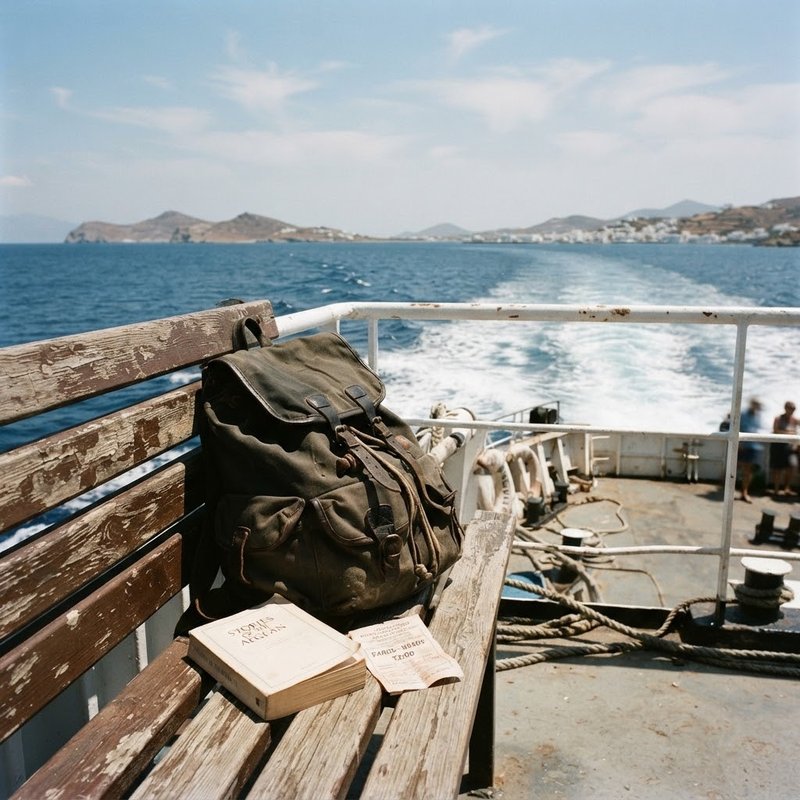
Keep these for photos taken on the water rather than at the terminal, since a pier shot deserves a different set. They work best when the frame shows nothing but grey, because the line then supplies the only detail the picture has.
- I came for the crossing and stayed for the sideways rain.
- Two hours of open water and one working socket on board.
- The timetable was a suggestion and the sea agreed with it.
- Deck chair, salt spray, and a book I never opened.
- We watched the shore fade instead of watching the clock.
- Coffee in a paper cup, horizon nowhere in sight.
- Half a bay of fog and one boat doing its shift.
- The crossing was free with the ticket and cost me a jacket.
Harbour and port lines
Use these when the boat is already tied up and the photo shows the cranes, the ropes or the queue for the bus. A port photo usually has enough hard edges, so the line can stay short.
- Moorings, gulls, and a schedule held together with tape.
- The harbour looked hand-washed after three days of wind.
- Everything smelled of diesel and salt, my favourite port smell.
- One lighthouse still doing its shift at the end of the day.
- Rope, rust, and a cafe that opens when the ferry does.
- The town starts where the last container ends.
- Two languages on the announcements, both of them muffled.
- Bags on the trolley, coffee going cold on the rail.
- The last bus left with the passengers, the next one is a rumour.
Short lines for postcards
Postcards have no room for a scene, so these stay under eight words and carry one image each. Handwriting eats space faster than a caption does, which is why the shortest group is also the most useful one.
- Sailing close to the edge of the timetable.
- Wet deck, warm coat, no complaints.
- Land ho, eventually, after the fog cleared.
- Out of office, out of signal.
- Current mood: on the wrong side of the water.
- Weather report: sideways, again.
- Boarded for the view, stayed for the engine noise.
- Crossing number three and still no horizon.
- The sea kept its own schedule all week.
How to place one without overdoing it
A pun works when the photo already carries the location, so the line can afford to be light. If the frame needs explaining, write the fact first and leave the joke for a later post in the same trip.
One per photo is the limit I keep for myself, and never two in a row in a grid, because readers scroll quickly and repetition turns a small joke into a personality they did not ask for. The set reads better when only one frame in six is carrying a joke at all.
Placement also depends on the platform. Under a square photo on a phone the line sits in the first two rows where it gets read, while the same line buried at the end of a long caption is skipped by everyone, including me a week later.
Writing your own
Start from the fact you would mention out loud when someone asks how the crossing went. Late boat, cold deck, refund, missed connection: the material is already sitting in the notes app from the day itself.
Then cut it to the shortest version that still holds the detail, and read it once without the photo. If the line makes sense alone and still fits the frame, it goes in the book; if it only works with the picture beside it, it is a caption rather than a pun.
Words that rhyme with tide, ride or deck are the ones I reach for first, and most of them die on the second reading. The lines that survive usually hide their joke in the middle of an ordinary sentence, so the reader gets the fact and the humour in the same breath.
Lines I have retired
Three of the earliest ones still sit in the notebook with a line through them. They leaned on a weather report instead of a scene, they repeated a word from the caption above, or they were funny only after I explained them in the comments.
Retiring a line is the cheapest editing there is, and it leaves the list short enough that I can read all of it before the boat leaves. That is the point of keeping one: when the deck goes by in a blur, the right words are already written and waiting.